Monday, June 11, 2018

How a Few Pages Can Make or Break Your Website

Posted by Jeff_Baker

A prospect unequivocally disagreed with a recommendation I made recently.

I told him a few pages of content could make a significant impact on his site. Even when presented with hard numbers backing up my assertions, he still balked. My ego started gnawing: would a painter tell a mathematician how to do trigonometry?

Unlike art, content marketing and SEO aren’t subjective. The quality of the words you write can be quantified, and they can generate a return for your business.

Most of your content won't do anything

In order to have this conversation, we really need to deal with this fact.

Most content created lives deep on page 7 of Google, ranking for an obscure keyword completely unrelated to your brand. A lack of scientific (objective math) process is to blame. But more on that later.

Case in point: Brafton used to employ a volume play with regard to content strategy. Volume = keyword rankings. It was spray-and-pray, and it worked.

Looking back on current performance for old articles, we find that the top 100 pages of our site (1.2% of all indexed pages) drive 68% of all organic traffic.

Further, 94.5% of all indexed pages drive five clicks or less from search every three months.

So what gives?

Here’s what has changed: easy content is a thing of the past. Writing content and “using keywords” is a plan destined for a lonely death on page 7 of the search results. The process for creating content needs to be rigorous and heavily supported by data. It needs to start with keyword research.

1. Keyword research:

Select content topics from keywords that are regularly being searched. Search volume implies interest, which guarantees what you are writing about is of interest to your target audience. The keywords you choose also need to be reasonable. Using organic difficulty metrics from Moz or SEMrush will help you determine if you stand a realistic chance of ranking somewhere meaningful.

2. SEO content writing:

Your goal is to get the page you’re writing to rank for the keyword you’re targeting. The days of using a keyword in blog posts and linking to a product landing page are over. One page, one keyword. Therefore, if you want your page to rank for the chosen keyword, that page must be the very best piece of content on the web for that keyword. It needs to be in-depth, covering a wide swath of related topics.

How to project results

Build out your initial list of keyword targets. Filter the list down to the keywords with the optimal combination of search volume, organic difficulty, SERP crowding, and searcher intent. You can use this template as a guide — just make a copy and you're set.

Get the keyword target template

Once you’ve narrowed down your list to top contenders, tally up the total search volume potential — this is the total number of searches that are made on a monthly basis for all your keyword targets. You will not capture this total number of searches. A good rule of thumb is that if you rank, on average, at the bottom of page 1 and top of page 2 for all keywords, your estimated CTR will be a maximum of 2%. The mid-bottom of page 1 will be around 4%. The top-to-middle of page 1 will be 6%.

In the instance above, if we were to rank poorly, with a 2% CTR for 20 pages, we would drive an additional 42–89 targeted, commercial-intent visitors per month.

The website in question drives an average of 343 organic visitors per month, via a random assortment of keywords from 7,850 indexed pages in Google. At the very worst, 20 pages, or .3% of all pages, would drive 10.9% of all traffic. At best (if the client followed the steps above to a T), the .3% additional pages would drive 43.7% of all traffic!

Whoa.

That’s .3% of a site’s indexed pages driving an additional 77.6% of traffic every. single. month.

How a few pages can make a difference

Up until now, everything we’ve discussed has been hypothetical keyword potential. Fortunately, we have tested this method with 37 core landing pages on our site (.5% of all indexed pages). The result of deploying the method above was 24 of our targeted keywords ranking on page 1, driving an estimated 716 high-intent visitors per month.

That amounts to .5% of all pages driving 7.7% of all traffic. At an average CPC of $12.05 per keyword, the total cost of paying for these keywords would be $8,628 per month.

Our 37 pages (.5% of all pages), which were a one-time investment, drive 7.7% of all traffic at an estimated value of $103,533 yearly.

Can a few pages make or break your website? You bet your butt.


Sign up for The Moz Top 10, a semimonthly mailer updating you on the top ten hottest pieces of SEO news, tips, and rad links uncovered by the Moz team. Think of it as your exclusive digest of stuff you don't have time to hunt down but want to read!

Friday, June 8, 2018

Risk-Averse Link Building - Whiteboard Friday

Posted by rjonesx.

Building links is an incredibly common request of agencies and consultants, and some ways to go about it are far more advisable than others. Whether you're likely to be asked for this work or you're looking to hire someone for it, it's a good idea to have a few rules of thumb. In today's Whiteboard Friday, Russ Jones breaks things down.

Risk Averse Links

Click on the whiteboard image above to open a high-resolution version in a new tab!

Video Transcription

Hey, folks, welcome to another great Whiteboard Friday. I am Russ Jones, Principal Search Scientist here at Moz. I get to do a lot of great research, but I'll tell you, my first love in SEO is link building. The 10 years I spent before joining Moz, I worked at an agency and we did a lot of it, and I'll tell you, there's nothing more exciting than getting that great link.

Now, today I'm going to focus a little bit more on the agency and consultant side. But one takeaway before we get started, for anybody out there who's using agencies or who's looking to use a consultant for link building, is kind of flip this whole presentation on its head. When I'm giving advice to agencies, you should use that as rules of thumb for judging whether or not you want to use an agency in the future. So let me jump right in and we'll get going.

What I'm going to talk about today is risk-averse link building. So the vast majority of agencies out there really want to provide good links for their customers, but they just don't know how. Let's admit it. The majority of SEO agencies and consultants don't do their own link building, or if they do, it's either guest posting or maybe known placements in popular magazines or online websites where you can get links. There's like a list that will go around of how much it costs to get an article on, well, Forbes doesn't even count anymore because they've no-followed their links, but that's about it. It's nothing special.

So today I want to talk through how you can actually build really good links for your customers and what really the framework is that you need to be looking into to make sure you're risk averse so that your customers can come out of this picture with a stronger link profile and without actually adopting much risk.

1. Never build a link you can't remove!

So we're going to touch on a couple of maxims or truisms. The first one is never build a link you can't remove. I didn't come upon this one until after Penguin, but it just occurred to me it is such a nightmare to get rid of links. Even with disavow, often it feels better that you can just get the link pulled from the web. Now, with negative SEO as being potentially an issue, admittedly Google is trying to devalue links as opposed to penalize, but still the rule holds strong. Never build a link that you can't remove.

But how do you do that? I mean you don't have necessarily control over it. Well, first off, there's a difference between earnings links and building links. So if you get a link out there that you didn't do anything for, you just got it because you wrote great content, don't worry about it. But if you're actually going to actively link build, you need to follow this rule, and there are actually some interesting ways that we can go about it.

Canonical "burn" pages

The first one is the methodology that I call canonical burn pages. I'm sure that sounds a little dark. But it actually is essentially just an insurance policy on your links. The idea is don't put all of your content value and link value into the same bucket. It works like this. Let's say this article or this Whiteboard Friday goes up at the URL risk-averse-links and Moz decided to do some outreach-based link building. Well, then I might make another version, risk-averse-linkbuilding, and then in my out linking actually request that people link to that version of the page. That page will be identical, and it will have a canonical tag so that all of the link value should pass back to the original.

Now, I'm not asking you to build a thousand doorway pages or anything of that sort, but here's the reason for the separation. Let's say you reach out to one of these webmasters and they're like, "This is great," and they throw it up on a blog post, and what they don't tell you is, "Oh yeah, I've got 100 other blogs in my link farm, and I'm just going to syndicate this out." Now you've got a ton of link spam pointing to the page. Well, you don't want that pointing to your site. The chances this guy is going to go remove his link from those hundreds if not thousands of pages are very low. Well, the worst case scenario here is that you've lost this page, the link page, and you drop it and you create a new one of these burn pages and keep going.

Or what if the opposite happens? When you actually start ranking because of this great content that you've produced and you've done great link building and somebody gets upset and decides to spam the page that's ranking with a ton of links, we saw this all the time in the legal sector, which was shocking to me. You would think you would never spam a lawyer, but apparently lawyers aren't afraid of another lawyer.

But regardless, what we could do in those situations is simply get rid of the original page and leave the canonical page that has all the links. So what you've done is sort of divided your eggs into different baskets without actually losing the ranking potential. So we call these canonical burn pages. If you have questions about this, I can talk more about it in the comments.

Know thy link provider

The other thing that's just stupidly obvious is you should know thy link provider. If you are getting your links from a website that says pay $50 for so and so package and you'll get x-links from these sources on Tier 2, you're never going to be able to remove those links once you get them unless you're using something like a canonical burn page. But in those cases where you're trying to get good links, actually build a relationship where the person understands that you might need to remove this link in the future. It's going to mean you lose some links, but in the long run, it's going to protect you and your customers.

That's where the selling point becomes really strong. Imagine you're on a client call, sales call and someone comes to you and they say they want link building. They've been burned before. They know what it's like to get a penalty. They know what it's like to have somebody tell them, "I just don't know how to do it."

Well, what if you can tell them, hey, we can link build for you and we are so confident in the quality of our offering that we can promise you, guarantee that we can remove the links we build for you within 7 days, 14 days, whatever number it ends up taking your team to actually do? That kind of insurance policy that you just put on top of your product is priceless to a customer who's worried about the potential harm that links might bring.

2. You can't trade anything for a link (except user value)!

Now this leads me to number two. This is the simplest way to describe following Google's guidelines, which is you can't trade anything for a link except user value. Now, I'm going to admit something here. A lot of folks who are watching this who know me know this, but my old company years and years and years ago did a lot of link buying. At the time, I justified it because I frankly thought that was the only way to do it. We had a fantastic link builder who worked for us, and he wanted to move up in the company. We just didn't have the space for him. We said to him, "Look, it's probably better for you to just go on your own."

Within a year of leaving, he had made over a million dollars selling a site that he ranked only using white hat link building tactics because he was a master of outreach. From that day on, just everything changed. You don't have to cheat to get good links. It's just true. You have to work, but you don't have to cheat. So just do it already. There are tons of ways to justify outreach to a website to say it's worth getting a link.

So, for example, you could

  • Build some tools and reach out to websites that might want to link to those tools.
  • You can offer data or images.
  • Accessibility. Find great content out there that's inaccessible or isn't useful for individuals who might need screen readers. Just recreate the content and follow the guidelines for accessibility and reach out to everybody who links to that site. Now you've got a reason to say, "Look, it's a great web page, but unfortunately a certain percentage of the population can't use it. Why don't you offer, as well as the existing link, one to your accessible version?"
  • Broken link replacement.
  • Skyscraper content, which is where you just create fantastic content. Brian Dean over at Backlinko has a fantastic guide to that.

There are just so many ways to get good links.

Let me put it just a different way. You should be embarrassed if you cannot create content that is worth outreach. In fact, that word "embarrassment," if you are embarrassed to email someone about your content, then it means you haven't created good enough content. As an SEO, that's your responsibility. So just sit down and spend some more time thinking about this. You can do it. I've seen it happen thousands of times, and you can end up building much better links than you ever would otherwise.

3. Tool up!

The last thing I would say is tool up. Look, better metrics and better workflows come from tools. There are lots of different ways to do this.

First off, you need a good backlink tool. While, frankly, Moz wasn't doing a good job for many years, but our new Link Explorer is 29 trillion links strong and it's fantastic. There's also Fresh Web Explorer for doing mentions. So you can find websites that talk about you but don't link. You're also going to want some tools that might do more specific link prospecting, like LinkProspector.com or Ontolo or BrokenLinkBuilding.com, and then some outreach tools like Pitchbox and BuzzStream.

But once you figure out those stacks, your link building stack, you're going to be able to produce links reliably for customers. I'm going to tell you, there is nothing that will improve your street cred and your brand reputation than link building. Link building is street cred in our industry. There is nothing more powerful than saying, "Yeah, we built a couple thousand links last year for our customers," and you don't have to say, "Oh, we bought," or, "We outsourced." It's just, "We just do link building, and we're good at it."

So I guess my takeaway from all of this is that it's really not as terrible as you think it is. At the end of the day, if you can master this process of link building, your agency will be going from a dime a dozen, where there are 100 in an averaged-sized city in the United States, to being a leading provider in the country just by simply mastering link building. If you follow the first two rules and properly tool up, you're well on your way.

So I hope to talk more to you in the comments below. If you have any questions, I can refer you to some other guides out there, including some former Whiteboard Fridays that will give you some great link building tips. Hope to talk to you soon.

Video transcription by Speechpad.com


Sign up for The Moz Top 10, a semimonthly mailer updating you on the top ten hottest pieces of SEO news, tips, and rad links uncovered by the Moz team. Think of it as your exclusive digest of stuff you don't have time to hunt down but want to read!

Wednesday, June 6, 2018

Beyond Youtube: Video Hosting, Marketing, and Monetization Platforms, Compared

Posted by AnnSmarty

A few weeks ago I did a step-by-step article on building up your YouTube presence. When writing the article, I immediately had a follow-up idea on expanding my tips beyond YouTube. Since then, some of the comments have confirmed the need for this follow-up.

The increasing interest in video marketing and diversifying your efforts is not surprising: According to HubSpot’s research 45% of web users watch an hour or more of video per day. That’s a lot if time our customers spend watching videos! And it's projected that by 2020, 82% of all consumer web traffic will be video.

Obviously, if you are seriously entering the video marketing arena, limiting yourself to YouTube alone is not a smart idea, just like limiting yourself to any one marketing channel is probably never a good way to go.

With that in mind, what other options do we have?

More video hosting options

YouTube is not the only major video hosting platform out there. There are a few solid options that you want to consider. Here are three additional platforms and how they fit different needs:


YouTube

Vimeo Pro

Vimeo Business

Wistia

Cost

Free

$20 /m

$50 /m

$99 /m

What's included

Unlimited videos

20GB per week

5TB per week

10 videos a month

Lead generation

No

No

Yes

Yes

Customizable player

No

Yes

Yes

Yes

Collaboration

No

No

Yes

No

Publish native to Facebook & Twitter

No

Yes

Yes

No

Clickable links

No(*)

Yes

Yes

Yes

Domain-level privacy

No

Yes

Yes

Yes

Analytics

Yes

Yes

Yes

Yes (**)

Video schema

No

No

No

Yes

Customer support

No(*)

Yes

Yes

Yes

Cons

Crowded, no good way to send viewers to your site...

Often has issues with bandwidth; videos load slower. If you are looking for organic visibility, it's quite niche-specific (artists, etc.)

Most expensive

Best for

Anyone

Filmmakers

Agencies

Businesses

  • (*) Unless you become a YouTube Partner (which is next to impossible for new and medium-scale channels)
  • (**) I (as well as many reviewers) consider Wistia analytics much better than that of YouTube and Vimeo

Bottom line:

Choosing a video hosting platform is overwhelming but here are a few easy-to-digest takeaways from the above comparison:

  • YouTube is beyond competition. If you are into video marketing, you need to be there, at least for the sake of being discovered through their search and suggested videos. However, a YouTube account is only good for promoting the YouTube account. There's little chance to drive leads to your site or build solid income there. You do need to be there for branding, though. Besides, none of the other options will offer an opportunity for such a powerful organic spread.
  • If you are into creative film-making (artists and storytellers), you'll want to give Vimeo Pro a try. There's a big community there and you want to be part of it to find partners/clients.
  • If you are a video marketing agency, Vimeo Business may be your platform of choice (thanks to their collaboration and multi-user support)
  • If you mostly need videos to embed on your landing pages, Wistia will save you tons of time. It's the easiest to use and understand. No extra training needed. You don't have to be an experienced filmmaker OR marketer to understand how it works and use its analytics.

Video courses and on-demand video

These days, anyone can create their own on-demand video channel. Isn't it awesome? It's also a very smart way to monetize your videos without forcing your viewers into clicking any ads or buying any affiliate stuff you didn't create.

When consolidating your video marketing efforts into your own on-demand video channel, there are important goals to keep in mind (targeting at least several at a time being the smartest approach):

  • Creating a knowledge base around your product
  • Positioning your brand as a knowledge hub in your niche
  • Building up an additional conversion funnel (for those people who are not ready to buy yet)

To me, creating a video subscription channel seems to be a perfect way to monetize your video creation efforts for two very appealing reasons:

  1. You create a product of your own which you are able to sell. With that comes an ocean of opportunities, from enhanced branding to an ability to expand your reach to many more platforms where you can sell your product from.
  2. You build and nurture your own micro-community, which (if you do things right) are able to spread your word, refer more people to join and support you in your other endeavors.

With that in mind, which options do we have to create our own video course?

Not surprisingly, there are quite a few platforms that fall into two major groups:

  • Revenue sharing platforms. The power of those is that they are interested in selling your courses and there's usually a community to market your course to. That benefit also creates one major drawback: Expect these platforms to dictate you how to format and market your course. Udemy is the best known example here: I started using it mostly for branding and quickly got discouraged due to their multiple restrictions and poor customer support. Still, it's a good place to start.
  • VOD (video-on-demand) platforms. These will charge you a monthly fee but they will come with awesome marketing features and integrations, as well as total freedom as to what you want to do with your content and your audience. Like with anything, you get what you pay for.Uscreen is a big player here: You can choose your payment model, use your own domain, brand your course the way you want to, send email marketing emails to your students, and even create a custom smart phone app to give your students an alternative on-the-go way to consume your brand-owned content:

Uscreen course

Bottom line:

Like with video marketing platforms, there's nothing preventing you from using both of the above options (for example, you can sell a lighter version of your course on Udemy and keep a more advanced, regularly updated version for your own domain) but just to give you an idea:

  • Udemy is best if you are very new to course creation and have no budget to start. It also makes it easy to keep an eye on competitors and understand your audience better by watching what and how they rate and review
  • Uscreen is a logical step further: Once you get more comfortable and have accumulated some videos you may want to bring it to the next level, i.e. create your own branded spot to engage your community better and build an alternative source of income.

Live streaming

Live streaming refers recording and simultaneously broadcasting your video to your audience in real time.

Live streaming has been getting bigger for a few years now and there's nothing that would signal an upcoming slow-down.

The biggest players here are:

  • YouTube Live
  • Facebook Live
  • Periscope

All the above options are very interactive and engaging: You can see your viewers' comments and reactions as you are streaming the video and you are able to address them right away.

In this case, your choice depends on your own marketing background: Stick to whatever channel currently works best for you in terms of follower/subscriber base and engagement.

Personally, Facebook is my preferred way to stream videos, not because of the actual audience size but because Facebook audience is more engaged. Besides, Facebook sends a notification to my friends whenever I go live which always results in more views.

But it's possible that we don't have to choose...

There are a couple of services that claim to stream "simultaneously" to several of the major platforms which is something I haven't tried yet but I am definitely planning to. If you like the idea, here's what I have been able to find so far:


Vimeo Live

Crowdcast Multistreams

Supported platforms

"Vimeo and Facebook, YouTube, or your favorite RTMP destinations"

"Facebook Live, Periscope, YouTube Live, and more"

Cost

$75 per month

$89 per month

Extra Pros

Comes with all Vimeo Business features (analytics, collaboration, hosting, etc.)

Comes with nice webinar hosting features

More tools to amplify your video marketing

In my previous article I listed lots of video creation and marketing tools and I didn't want to leave you with no tools here as well.

If you have read up to this point, you must be very serious about your video marketing efforts. So to award you, here are a few awesome tools you may want to take note of:

Create: Lumen5

Here's a nice tool I failed to mention in my previous post: Lumen5. If you are looking for an easy start for your video marketing campaign, take a look at this tool. It turns blog posts into videos and the result is pretty awesome.

lumen5

I don't mean to say this tool is enough for a well-rounded video marketing campaign but it's definitely a nice way to re-package your text content and broadcast your articles to video-only channels, like Youtube and Vimeo.

Monetize: Patreon

Apart from selling your videos as a separate project, there's another cool way to monetize your video activity.

Patreon is nice platform aiming to help independent video creators: Set up your page and invite your social media followers to support your video creation efforts by a small monthly subscription. If you don't want to sell anything, that's a nice way to earn your living by engaging your supporters:

patreon

You can learn more on how it works from its current user here.

Monitor: Awario

There's never one perfect method of doing marketing. There's always a need to try different tools, formats and platforms. Monitoring your competitors is one great way to discover more of those tactics to play with.

Awario is a great solution to use for competitive multi-channel monitoring. They support all major media including Twitter, Facebook, YouTube, Reddit, blogs and more. You can easily filter out any channel to clear out clutter. YouTube monitoring is a life saver when it comes to keeping an eye on what your competitor is doing video-wise:

awario

When it comes to video marketing, I am not aware of any other solution for monitoring video content.

Conclusion

  • You don’t have to limit yourself to YouTube for video hosting, but you cannot really do without YouTube altogether.
  • When it comes to YouTube, it’s a powerful video discovery engine but there’s not much you can do to direct those viewers to your own site. You need to be there to be discovered, though.
  • When it comes to other video hosting platforms, every solution serves its own purpose, so choose one that will serve your needs best.
  • If you want to consolidate your video marketing efforts (which is a smart and logical step further), create your own on-demand video channel. These days it’s pretty easy and affordable.
  • Video live streaming is a great way to earn organic social media visibility. Choose your platform to stream based on your current level of engagement and reach. Or, try paid solutions that allow to stream to multiple platforms simultaneously

Are there more tools and platforms you are using? Let us know in the comments!


Sign up for The Moz Top 10, a semimonthly mailer updating you on the top ten hottest pieces of SEO news, tips, and rad links uncovered by the Moz team. Think of it as your exclusive digest of stuff you don't have time to hunt down but want to read!

Tuesday, June 5, 2018

Looking Beyond Keywords: How to Drive Conversion with Visual Search & Search by Camera

Posted by Jes.Scholz

Let’s play a game. I’ll show you an image. You type in the keyword to find the exact product featured in the image online. Ready?

Google her sunglasses…

What did you type? Brown sunglasses? Brown sunglasses with heavy frame? Retro-look brown sunglasses with heavy frame? It doesn’t matter how long-tail you go, it will be difficult to find that exact pair, if not impossible. And you’re not alone.

For 74% of consumers, traditional text-based keyword searches are inefficient at helping find the right products online.

But much of your current search behavior is based on the false premise that you can describe things in words. In many situations, we can’t.

And this shows in the data. Sometimes we forget that Google Images accounts for 22.6% of all searches — searches where traditional methods of searching were not the best fit.

Image credit: Sparktoro

But I know what you’re thinking. Image SEO drives few to no sessions, let alone conversions. Why should I invest my limited resources into visual marketing?

Because humans are visual creatures. And now, so too are mobile phones — with big screens, multiple cameras, and strong depth perception.

Developments in computer vision have led to a visual marketing renaissance. Just look to visual search leader Pinterest, who reported that 55% of their users shop on the platform. How well do those users convert? Heap Analytics data shows that on shopping cart sizes under $199, image-based Pinterest Ads have an 8.5% conversion rate. To put that in context, that's behind Google’s 12.3% but in front of Facebook’s 7.2%.

Not only can visual search drive significant conversions online. Image recognition is also driving the digitalization and monetization in the real world.

The rise of visual search in Google

Traditionally, image search functioned like this: Google took a text-based query and tried to find the best visual match based on metadata, markups, and surrounding copy.

But for many years now, the image itself can also act as the search query. Google can search for images with images. This is called visual search.

Google has been quietly adding advanced image recognition capabilities to mobile Google Images over the last years, with a focus on the fashion industry as a test case for commercial opportunities (although the functionality can be applied to automotive, travel, food, and many other industries). Plotting the updates, you can see clear stepping stone technologies building on the theme of visual search.

  • Related images (April 2013): Click on a result to view visually similar images. The first foray into visual search.
  • Collections (November 2015): Allows users to save images directly from Google’s mobile image search into folders. Google’s answer to a Pinterest board.
  • Product images in web results (October 2016): Product images begin to display next to website links in mobile search.
  • Product details on images (December 2016): Click on an image result to display product price, availability, ratings, and other key information directly in the image search results.
  • Similar items (April 2017): Google can identify products, even within lifestyle images, and showcases similar items you can buy online.
  • Style ideas (April 2017): The flip side to similar items. When browsing fashion product images on mobile, Google shows you outfit montages and inspirational lifestyle photos to highlight how the product can be worn in real life.
  • Image badges (August 2017): Label on the image indicate what other details are available, encouraging more users to click; for example, badges such as “recipe” or a timestamp for pages featuring videos. But the most significant badge is “product,” shown if the item is available for purchase online.
  • Image captions (March 2018): Display the title tag and domain underneath the image.

Combining these together, you can see powerful functionality. Google is making a play to turn Google Images into shoppable product discovery — trying to take a bite out of social discovery platforms and give consumers yet another reason to browse on Google, rather than your e-commerce website.

Image credit: Google

What’s more, Google is subtly leveraging the power of keyword search to enlighten users about these new features. According to 1st May MozCast, 18% of text-based Google searches have image blocks, which drive users into Google Images.

This fundamental change in Google Image search comes with a big SEO opportunity for early adopters. Not only for transactional queries, but higher up the funnel with informational queries as well.

kate-middleton-style.gif

Let’s say you sell designer fashion. You could not only rank #1 with your blog post on a informational query on “kate middleton style,” including an image on your article result to enhance the clickability of your SERP listing. You can rank again on page 1 within the image pack, then have your products featured in Similar Items — all of which drives more high-quality users to your site.

And the good news? This is super simple to implement.

How to drive organic sessions with visual search

The new visual search capabilities are all algorithmically selected based on a combination of schema and image recognition. Google told TechCrunch:

“The images that appear in both the style ideas and similar items grids are also algorithmically ranked, and will prioritize those that focus on a particular product type or that appear as a complete look and are from authoritative sites.”

This means on top of continuing to establish Domain Authority site-wide, you need images that are original, high resolution, and clearly focus on a single theme. But most importantly, you need images with perfectly implemented structured markup to rank in Google Images.

To rank your images, follow these four simple steps:

1. Implement schema markup

To be eligible for similar items, you need product markup on the host page that meets the minimum metadata requirements of:

  • Name
  • Image
  • Price
  • Currency
  • Availability

But the more quality detail, the better, as it will make your results more clickable.

2. Check your implementation

Validate your implementation by running a few URLs through Google’s Structured Data Testing Tool. But remember, just being valid is sometimes not enough. Be sure to look into the individual field result to ensure the data is correctly populating and user-friendly.

3. Get indexed

Be aware, it can take up to one week for your site’s images to be crawled. This will be helped along by submitting an image XML sitemap in Google Search Console.

4. Look to Google Images on mobile

Check your implementation by doing a site:yourdomain.cctld query on mobile in Google Images.

If you see no image results badges, you likely have an implementation issue. Go back to step 2. If you see badges, click a couple to ensure they show your ideal markup in the details.

Once you confirm all is well, then you can begin to search for your targeted keywords to see how and where you rank.

Like all schema markup, how items display in search results is at Google’s discretion and not guaranteed. However, quality markup will increase the chance of your images showing up.

It’s not always about Google

Visual search is not limited to Google. And no, I’m not talking about just Bing. Visual search is also creating opportunities to be found and drive conversion on social networks, such as Pinterest. Both brands allow you to select objects within images to narrow down your visual search query.

Image credit: MarTech Today

On top of this, we also have shoppable visual content on the rise, bridging the gap between browsing and buying. Although at present, this is more often driven by data feeds and tagging more so than computer vision. For example:

  • Brahmin offers shoppable catalogs
  • Topshop features user-generated shoppable galleries
  • Net-a-Porter’s online magazine features shoppable article
  • Ted Baker’s campaigns with shoppable videos
  • Instagram & Pinterest both monetize with shoppable social media posts

Such formats reduce the number of steps users need to take from content to conversion. And more importantly for SEOs, they exclude the need for keyword search.

I see a pair of sunglasses on Instagram. I don’t need to Google the name, then click on the product page and then convert. I use the image as my search query, and I convert. One click. No keywords.

...But what if I see those sunglasses offline?

Digitize the world with camera-based search

The current paradigm for SEOs is that we wait for a keyword search to occur, and then compete. Not only for organic rankings, but also for attention versus paid ads and other rich features.

With computer vision, you can cut the keyword search out of the customer journey. By entering the funnel before the keyword search occurs, you can effectively exclude your competitors.

Who cares if your competitor has the #1 organic spot on Google, or if they have more budget for Adwords, or a stronger core value proposition messaging, if consumers never see it?

Consumers can skip straight from desire to conversion by taking a photo with their smartphone.

Brands taking search by camera mainstream

Search by camera is well known thanks to Pinterest Lens. Built into the app, simply point your camera phone at a product discovered offline for online recommendations of similar items.

If you point Lens at a pair of red sneakers, it will find you visually similar sneakers as well as idea on how to style it.

Image credit: Pinterest

But camera search is not limited to only e-commerce or fashion applications.

Say you take a photo of strawberries. Pinterest understand you’re not looking for more pictures of strawberries, but for inspiration, so you'll see recipe ideas.

The problem? For you, or your consumers, Pinterest is unlikely to be a day-to-day app. To be competitive against keyword search, search by camera needs to become part of your daily habit.

Samsung understands this, integrating search by camera into their digital personal assistant Bixby, with functionality backed by powerful partnerships.

  • Pinterest Lens powers its images search
  • Amazon powers its product search
  • Google translates text
  • Foursquare helps to find places nearby

Bixby failed to take the market by storm, and so is unlikely to be your go-to digital personal assistant. Yet with the popularity of search by camera, it’s no surprise that Google has recently launched their own version of Lens in Google Assistant.

Search engines, social networks, and e-commerce giants are all investing in search by camera...

...because of impressive impacts on KPIs. BloomReach reported that e-commerce websites reached by search by camera resulted in:

  • 48% more product views
  • 75% greater likelihood to return
  • 51% higher time on site
  • 9% higher average order value

Camera search has become mainstream. So what’s your next step?

How to leverage computer vision for your brand

As a marketer, your job is to find the right use case for your brand, that perfect point where either visual search or search by camera can reduce friction in conversion flows.

Many case studies are centered around snap-to-shop. See an item you like in a friend's home, at the office, or walking past you on the street? Computer vision takes you directly from picture to purchase.

But the applications of image recognition are only limited by your vision. Think bigger.

Branded billboards, magazines ads, product packaging, even your brick-and-mortar storefront displays all become directly actionable. Digitalization with snap-to-act via a camera phone offers more opportunities than QR codes on steroids.

If you run a marketplace website, you can use computer vision to classify products: Say a user wants to list a pair of shoes for sale. They simply snap a photo of the item. With that photo, you can automatically populate the fields for brand, color, category, subcategory, materials, etc., reducing the number of form fields to what is unique about this item, such as the price.

A travel company can offer snap-for-info on historical attractions, a museum on artworks, a healthy living app on calories in your lunch.

What about local SEO? Not only could computer vision show the rating or menu of your restaurant before the user walks inside, but you could put up a bus stop ad calling for hungry travelers to take a photo. The image triggers Google Maps, showing public transport directions to your restaurant. You can take the customer journey, quite literally. Tell them where to get off the bus.

And to build such functionality is relatively easy, because you don’t need to reinvent the wheel. There are many open-source image recognition APIs to help you leverage pre-trained image classifiers, or from which you can train your own:

  • Google Cloud Vision
  • Amazon Rekognition
  • IBM Watson
  • Salesforce Einstein
  • Slyce
  • Clarifai

Let’s make this actionable. You now know computer vision can greatly improve your user experience, conversion rate and sessions. To leverage this, you need to:

  1. Make your brand visual interactive through image recognition features
  2. Understand how consumers visually search for your products
  3. Optimize your content so it’s geared towards visual technology

Visual search is permeating online and camera search is becoming commonplace offline. Now is the time to outshine your competitors. Now is the time to understand the foundations of visual marketing. Both of these technologies are stepping stones that will lead the way to an augmented reality future.


Sign up for The Moz Top 10, a semimonthly mailer updating you on the top ten hottest pieces of SEO news, tips, and rad links uncovered by the Moz team. Think of it as your exclusive digest of stuff you don't have time to hunt down but want to read!

Friday, June 1, 2018

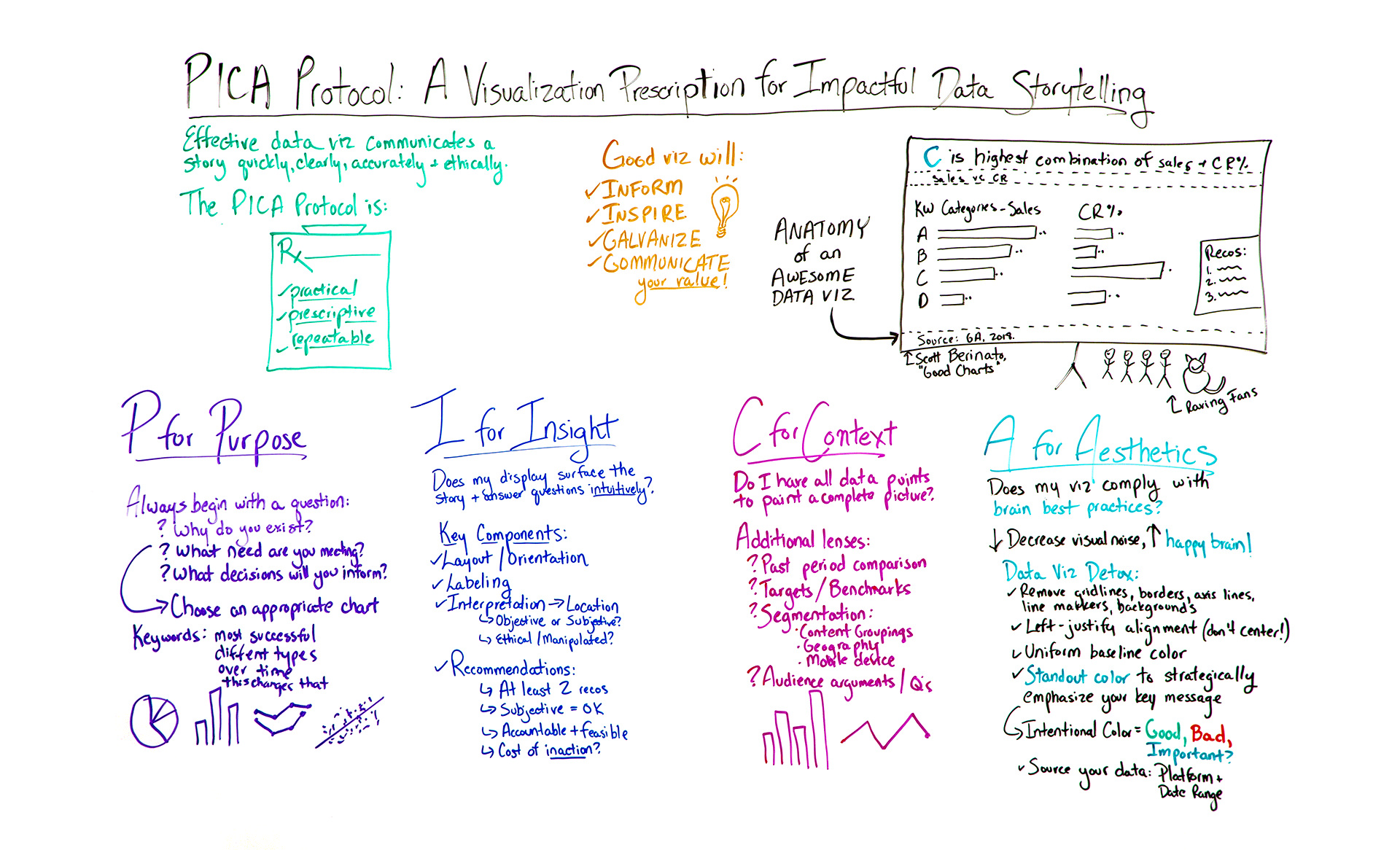
PICA Protocol: A Visualization Prescription for Impactful Data Storytelling - Whiteboard Friday

Posted by Lea-Pica

If you find your presentations are often met with a lukewarm reception, it's a sure sign it's time for you to invest in your data storytelling. By following a few smart rules, a structured approach to data visualization could make all the difference in how stakeholders receive and act upon your insights. In this edition of Whiteboard Friday, we're thrilled to welcome data viz expert Lea Pica to share her strategic methodology for creating highly effective charts.

A Visualization Prescription for Impactful Storytelling

Click on the whiteboard image above to open a high-resolution version in a new tab!

Video Transcription

Hello, Moz fans. Welcome to another edition of Whiteboard Friday. I'm here to talk to you this week about a very hot topic in the digital marketing space. So my name is Lea Pica, and I am a data storytelling trainer, coach, speaker, blogger, and podcaster at LeaPica.com.

I want to tell you a little story. So as 12 years I spent as a digital analyst and SEM, I used to present insights a lot, but nothing ever happened as a result of it. People fell asleep or never responded. No action was being taken. So I decided to figure out what was happening, and I learned all these great tricks for doing it.

What I learned in my journey is that effective data visualization communicates a story quickly, clearly, accurately, and ethically, and it had really four main goals — to inform decisions, to inspire action, to galvanize people, and most importantly to communicate the value of the work that you do.

Now, there are lots of things you can do, but I was struggling to find one specific process that was going to help me get from what I was trying to communicate to getting people to act on it. So I developed my own methodology. It's called the PICA Protocol, and it's a visualization prescription for impactful data storytelling. What I like about this protocol is that it's practical, approachable. It's not complicated. It's prescriptive, and it's repeatable. I believe it's going to get you where you need to go every time.

So let's say one of your managers, clients, stakeholders is asking you for something like, "What are our most successful keyword groups?" Something delightfully vague like that. Now, before you jump into your data visualization platform and start dropping charts like it's hot, I want you to take a step back and start with the first step in the process, which is P for purpose.

P for Purpose

So I found that every great data visualization started with a very focused question or questions.

  • Why do you exist? Get philosophical with it.
  • What need of my audience are you meeting?
  • What decisions are you going to inform?

These questions help you get really focused about what you're going to present and avoid the sort of needle in a haystack approach to seeing what might stick.

So the answers to these questions are going to help you make an important decision, to choose an appropriate chart type for the message that you're trying to convey. Some of the ways you want to do that — I hear you guys are like into keywords a little bit — you want to listen for the keywords of what people are asking you for. So in this case, we have "most successful." Okay, that indicates a comparison. Different types or campaigns or groups, those are categories. So it sounds like what we're going for is a categorical comparison. There are other kinds of keywords you can look for, like changing over time, how this affects that. Answers or opinions. All of those are going to help you determine your most appropriate visual.

Now, in this case, we have a categorical comparison, so I always go back to basics. It's an oldie but goodie, but we're going to do the tried-and-true bar chart. It's universally understood and doesn't have a learning curve. What I would not recommend are pie charts. No, no, no. Unless you only have two segments in your visual and one is unmistakably larger than the other, pie charts are not your best choice for communicating categorical comparison, composition, or ranking.

I for Insight

So we have our choice. We're now going to move on to the next step in the methodology, which is I for insight. So an insight is something that gives a person a capacity to understand something quickly, accurately, and intuitively. Think of those criteria.

So here, does my display surface the story and answer these questions intuitively? That's our criteria. The components of that are:

  • Layout and orientation. So how is the chart configured? Very often we'll use vertical bar charts for categorical comparison, but that will end up having diagonal labels if they're really long, and unless your audience walks around like this all the time, it's going to be confusing because that would be weird. So you want to make sure it's oriented well.
  • Labeling. In the case of bars, I always prefer to label each bar directly rather than relying on just an axis, because then their eyes aren't jumping from bar to axis to bar to axis and they're paying more attention to you. That's also for line charts. Very often I'll label a line with a maximum, a minimum, and maybe the most important data point.
  • Interpretation of the data and where we're placing it, the location.
    • So our interpretation, is it objective or is it subjective? So subjective words are like better or worse or stupid or awesome. Those are opinions. But objective words are higher, lower, most efficient, least efficient. So you really want your observations to be objective.
    • Have you presented it ethically? Or have you manipulated the view in a way that isn't telling a really ethical picture, like adjusting a bar axis above zero, which is a no-no? But you can do that with a line graph in certain cases. So look for those nuances. You want to basically ask yourself, "Would I be able to uphold this visual in a court of law or sleep at night?"
    • Location of that insight. So very often we'll put our insights, our interpretation down here or in really tiny letters up here. Then up here we'll put big letters saying this is sales, my keyword category. No. What we want to do is we want to put our interpretation up here. This top area is the most important real estate on your visual. That's where their eyes are going to look first. So think of this like a BuzzFeed headline for your visual. What do you want them to take away? You can always put what the chart is here in a little subtitle.
  • Make recommendations. Because that's what a really powerful visual is going to do.
    • I always suggest having two recommendations at least, because this way you're empowering your audience with a choice. This way you can actually be subjective. That is okay in this case, because that's your unique subject matter expertise.
    • Are your recommendations accountable to specific people? Are they feasible?
    • What's the cost of not acting on your recommendations? Put some urgency behind it. So I like to put my recommendations in a little box or callout on the side here so it's really clear after I've presented my facts.

C for Context

The next step in the methodology is C for context. What this is saying is, "Do I have all the data points I need to paint a complete picture, or is there more to this story?" So some additional lenses you might find useful are past period comparison, targets or benchmarks are useful, segmentation, things like geography, mobile device. Or what are the typical questions or arguments that your audience has when you present data? They can be super value contextual points.

In this case, I might decide that while they care about the number of sales, because that's most successful to them, I care about the keywords "conversion rates." So I'm going to add a second bar chart here like this, and I'm going to see there's a different story that's popping out here now.

Now, this is where your data storytelling really comes into play. This particular strategy is called a table lens or a side-by-side bar chart. It's what I recommend if you want to combine two categorical metrics together.

A for Aesthetics

Now, the last step in the methodology is A for aesthetics. Aesthetics are how things look. So it's not about making it look pretty. No, it's asking, "Does my viz comply with brain best practices of how we absorb information?"

1. Decrease visual noise

So the first step in doing that is we want to decrease visual noise, because that creates a lot of tension. So decreasing noise will increase the chance of a happy brain.

Now, I'm a crunchy granola hippie, so I love to detox every day. I've developed a data visualization detox that entails removing things like grid lines, borders, axis lines, line markers, and backgrounds. Get all of that junk out of there, really clean up. You can align everything to the left to make sure that the brain is following things properly down. Don't center everything.

2. Use uniform colors (plus one standout color for emphasis)

Now, you'll notice that most of my bars here have a uniform color — simple black. I like to color everything one color, because then I'll use a separate, standout color, like this blue, to strategically emphasize my key message. You might notice that I did that throughout this step for the words that I want you to pick out. That's why I colored these particular bars, because this feels like the story to me, because that is the storytelling part of this message.

Notice that I also colored the category in my observation to create a connective tissue between these two items. So using color intentionally means things like using green for good and red for bad, not arbitrarily, and then maybe blue for what's important.

3. Source your data

Then finally, you always want to source your data. That increases the trust. So you want to put your platform and your date range. Really simple.

So this is the anatomy of an awesome data viz. I've adapted it from a great book called "Good Charts" by my friend, Scott Berinato. What I have found that by using this protocol, you're going to end up with these wonderful, raving fans who are going to love your work and understand your value. I included a little kitty fan because I can. It's my Whiteboard Friday.

So that is the protocol. I actually have included a free gift for you today. If you click the link at the end of this post, you'll be able to sign up for a Chart Detox Checklist, a full printable PICA Protocol prescription and a Chart Choosing Guide.

Get the PICA Protocol prescription

I would actually love to hear from you. What are the kinds of struggles that you have in presenting your insights to stakeholders, where you just feel like they're not getting the value of what you're doing? I'd love to hear any questions you have about the methodology as well.

So thank you for watching this edition of Whiteboard Friday. I hope you enjoyed it. We'll see you next week, and please remember to viz responsibly, my friends. Namaste.

Video transcription by Speechpad.com


Sign up for The Moz Top 10, a semimonthly mailer updating you on the top ten hottest pieces of SEO news, tips, and rad links uncovered by the Moz team. Think of it as your exclusive digest of stuff you don't have time to hunt down but want to read!

Wednesday, May 30, 2018

Getting Real with Retail: An Agency’s Guide to Inspiring In-Store Excellence

Posted by MiriamEllis

A screenshot of a negative 1-star review citing poor customer service

No marketing agency staffer feels good when they see a retail client getting reviews like this on the web.

But we can find out why they’re happening, and if we’re going above-and-beyond in our work, we just might be able to catalyze turning things around if we’re committed to being honest with clients and have an actionable strategy for their in-store improvements.

In this post, I’ll highlight some advice from an internal letter at Tesla that I feel is highly applicable to the retail sector. I’d also like to help your agency combat the retail blues headlining the news these days with big brands downsizing, liquidating and closing up shop — I’m going to share a printable infographic with some statistics with you that are almost guaranteed to generate the client positivity so essential to making real change. And, for some further inspiration, I’d like to offer a couple of anecdotes involving an Igloo cooler, a monk, reindeer moss, and reviews.

The genuine pain of retail gone wrong: The elusive cooler, "Corporate," and the man who could hardly stand

“Hi there,” I greeted the staffer at the customer service counter of the big department store. “Where would I find a small cooler?”

“We don’t have any,” he mumbled.

“You don’t have any coolers? Like, an Igloo cooler to take on a picnic to keep things cold?”

“Maybe over there,” he waved his hand in unconcern.

And I stood there for a minute, expecting him to actually figure this out for me, maybe even guide me to the appropriate aisle, or ask a manager to assist my transaction, if necessary. But in his silence, I walked away.

“Hi there,” I tried with more specificity at the locally owned general store the next day. “Where would I find something like a small Igloo cooler to keep things cold on a picnic?”

“I don’t know,” the staffer replied.

“Oh…” I said, uncomfortably.

“It could be upstairs somewhere,” he hazarded, and left me to quest for the second floor, which appeared to be a possibly-non-code-compliant catch-all attic for random merchandise, where I applied to a second dimly illuminated employee who told me I should probably go downstairs and escalate my question to someone else.

And apparently escalation was necessary, for on the third try, a very tall man was able to lift his gaze to some coolers on a top shelf… within clear view of the checkout counter where the whole thing began.

Why do we all have experiences like this?

“Corporate tells us what to carry” is the almost defensive-sounding refrain I have now received from three employees at two different Whole Foods Markets when asking if they could special order items for me since the Amazon buyout.

Because, you know, before they were Amazon-Whole Foods, staffers would gladly offer to procure anything they didn’t have in stock. Now, if they stop carrying that Scandinavian vitamin D-3 made from the moss eaten by reindeer and I’ve got to have it because I don’t want the kind made by irradiating sheep wool, I’d have to special order an entire case of it to get my hands on a bottle. Because, you know, “Corporate.”

Why does the distance between corporate and customer make me feel like the store I’m standing in, and all of its employees, are powerless? Why am I, the customer, left feeling powerless?

So maybe my search for a cooler, my worries about access to reindeer moss, and the laughable customer service I’ve experienced don’t signal “genuine pain.” But this does:

Screenshot of a one-star review: "The pharmacy shows absolutely no concern for the sick, aged and disabled from what I see and experienced. There's 2 lines for drops and pick up, which is fine, but keep in mind those using the pharmacy are sick either acute or chronic. No one wants to be there. The lines are often long with the phone ringing off the hook, so very understaffed. There are no chairs near the line to sit even if someone is in so much pain they can hardly stand, waiting area not nearby. If you have to drop and pick you have to wait in 2 separate lines. They won't inform the other window even though they are just feet away from each other. I saw one poor man wait 4 people deep, leg bandaged, leaning on a cart to be able to stand, but he was in the wrong line and was told to go to the other line. They could have easily taken the script, asked him to wait in the waiting area, walk the script 5 feet, and call him when it was his turn, but this fella who could barely stand had to wait in another line, 4 people deep. I was in the correct line, pick up. I am a disabled senior with cancer and chronic pain. However, I had a new Rx insurance card, beginning of the year. I was told that to wait in the other line, too! I was in the correct line, but the staff was so poorly trained she couldn't enter a few new numbers. This stuff happens repeatedly there. I've written and called the home office who sound so concerned but nothing changes. I tried to talk to manager, who naturally was "unavailable" but his underling made it clear their process was more important than the customers. All they have to do to fix the problem is provide nearby sitting or ask the customer to wait in the waiting area where there are chairs and take care of the problem behind the counter, but they would rather treat the sick, injured and old like garbage than make a small change that would make a big difference to their customers. Although they are very close I am looking for a pharmacy who actually cares to transfer my scripts, because I feel they are so uncaring and disinterested although it's their job to help the sick."

This is genuine pain. When customer service is failing to the point that badly treated patrons are being further distressed by the sight of fellow shoppers meeting the same fate, the cause is likely built into company structure. And your marketing agency is looking at a bonafide reputation crisis that could presage things like lawsuits, impactful reputation damage, and even closure for your valuable clients.

When you encounter customer service disasters, it begs questions like:

  1. Could no one in my situation access a list of current store inventory, or, barring that, seek out merchandise with me instead of risking the loss of a sale?
  2. Could no one offer to let “corporate” know that I’m dissatisfied with a “customer service policy” that would require me to spend $225 to buy a whole case of vitamins? Why am I being treated like a warehouse instead of a person?
  3. Could no one at the pharmacy see a man with a leg wound about to fall over, grab a folding chair for him, and keep him safe, instead of risking a lawsuit?

I think a “no” answer to all three questions proceeds from definite causes. And I think Tesla CEO, Elon Musk, had such causes in mind when he recently penned a letter to his own employees.

“It must be okay for people to talk directly and just make the right thing happen.”

“Communication should travel via the shortest path necessary to get the job done, not through the 'chain of command.' Any manager who attempts to enforce chain of command communication will soon find themselves working elsewhere.

A major source of issues is poor communication between depts. The way to solve this is allow free flow of information between all levels. If, in order to get something done between depts, an individual contributor has to talk to their manager, who talks to a director, who talks to a VP, who talks to another VP, who talks to a director, who talks to a manager, who talks to someone doing the actual work, then super dumb things will happen. It must be ok for people to talk directly and just make the right thing happen.

In general, always pick common sense as your guide. If following a 'company rule' is obviously ridiculous in a particular situation, such that it would make for a great Dilbert cartoon, then the rule should change.”
- Elon Musk, CEO, Tesla

Let’s parlay this uncommon advice into retail. If it’s everyone’s job to access a free flow of information, use common sense, make the right thing happen, and change rules that don’t make sense, then:

  1. Inventory is known by all store staff, and my cooler can be promptly located by any employee, rather than workers appearing helpless.
  2. Employees have the power to push back and insist that, because customers still expect to be able to special order merchandise, a specific store location will maintain this service rather than disappoint consumers.
  3. Pharmacists can recognize that patrons are often quite ill and can immediately place some chairs near the pharmacy counter, rather than close their eyes to suffering.

“But wait,” retailers may say. “How can I trust that an employee’s idea of ‘common sense’ is reliable?”

Let’s ask a monk for the answer.

“He took the time...”

I recently had the pleasure of listening to a talk given by a monk who was defining what it meant to be a good leader. He hearkened back to his young days, and to the man who was then the leader of his community.

“He was a busy man, but he took the time to get to know each of us one-on-one, and to be sure that we knew him. He set an example for me, and I watched him,” the monk explained.

Most monasteries function within a set of established rules, many of which are centuries old. You can think of these guidelines as a sort of policy. In certain communities, it’s perfectly acceptable that some of the members live apart as hermits most of the year, only breaking their meditative existence by checking in with the larger group on important holidays to share what they’ve been working on solo. In others, every hour has its appointed task, from prayer, to farming, to feeding people, to engaging in social activism.

The point is that everyone within a given community knows the basic guidelines, because at some point, they’ve been well-communicated. Beyond that, it is up to the individual to see whether they can happily live out their personal expression within the policy.

It’s a lot like retail can be, when done right. And it hinges on the question:

“Has culture been well-enough communicated to every employee so that he or she can act like the CEO of the company would in wide variety of circumstances?”

Or to put it another way, would Amazon owner Jeff Bezos be powerless to get me my vitamins?

The most accessible modern benchmark of good customer service — the online review — is what tells the public whether the CEO has “set the example.” Reviews tell whether time has been taken to acquaint every staffer with the business that employs them, preparing them to fit their own personal expression within the company’s vision of serving the public.

An employee who is able to recognize that an injured patron needs a seat while awaiting his prescription should be empowered to act immediately, knowing that the larger company supports treating people well. If poor training, burdensome chains of command, or failure to share brand culture are obstacles to common-sense personal initiative, the problem must be traced back to the CEO and corrected, starting from there.

And, of course, should a random staffer’s personal expression genuinely include an insurmountable disregard for other people, they can always be told it’s time to leave the monastery...

For marketing agencies, opportunity knocks

So your agency is auditing a valuable incoming client, and their negative reviews citing dirty premises, broken fixtures, food poisoning, slowness, rudeness, cluelessness, and lack of apparent concern make you say to yourself,

“Well, I was hoping we could clean up the bad data on the local business listings for this enterprise, but unless they clean up their customer service at 150 of their worst-rated locations, how much ROI are we really going to be able to deliver? What’s going on at these places?”

Let’s make no bones about this: Your honesty at this critical juncture could mean the difference between survival and closure for the brand.

You need to bring it home to the most senior level person you can reach in the organization that no amount of honest marketing can cover up poor customer service in the era of online reviews. If the brand has fallen to the level of the pharmacy I’ve cited, structural change is an absolute necessity. You can ask the tough questions, ask for an explanation of the bad reviews.

“But I’m just a digital marketer,” you may think. “I’m not in charge of whatever happens offline.”

Think again.

Headlines in retail land are horrid right now:

If you were a retail brand C-suite and were swallowing these predictions of doom with your daily breakfast, wouldn’t you be looking for inspiration from anyone with genuine insight? And if a marketing agency should make it their business to confront the truth while also being the bearer of some better news, wouldn’t you be ready to listen?

What is the truth? That poor reviews are symptoms smart doctors can use for diagnosis of structural problems.
What is the better news? The retail scenario is not nearly as dire as it may seem.

Why let hierarchy and traditional roles hold your agency back? Tesla wouldn’t. Why not roll up your sleeves and step into in-store? Organize and then translate the narrative negative reviews are telling about structural problems for the brand which have resulted in dangerously bad customer service. And then, be prepared to counter corporate inertia born of fear with some eye-opening statistics.

Print and share some good retail tidings

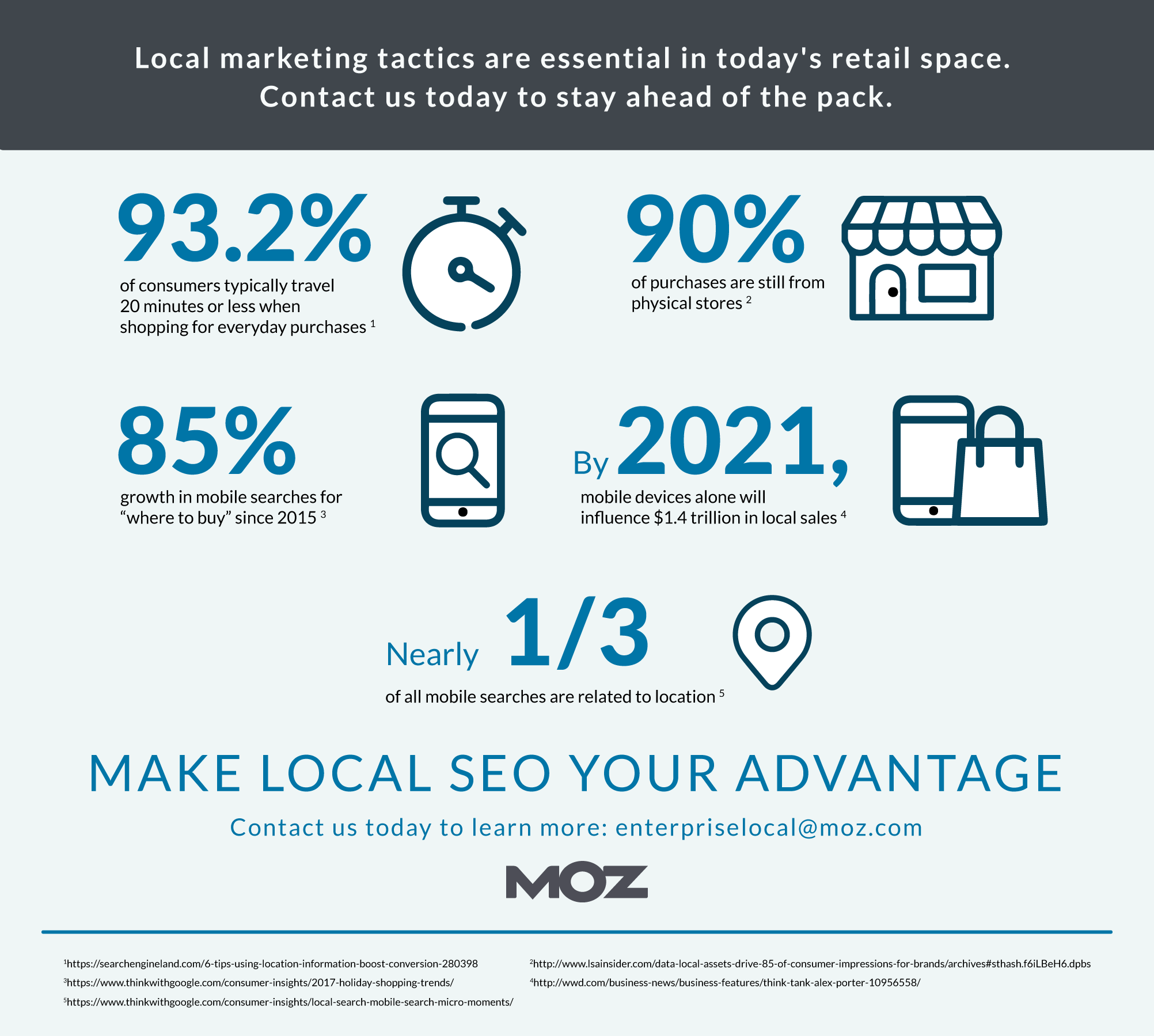
Local SEO infographic

Print your own copy of this infographic to share with clients.

At Moz, we’re working with enterprises to get their basic location data into shape so that they are ready to win their share of the predicted $1.4 trillion in mobile-influenced local sales by 2021, and your agency can use these same numbers to combat indecision and apathy for your retail clients. Look at that second statistic again: 90% of purchases are still happening in physical stores. At Moz, we ask our customers if their data is ready for this. Your agency can ask its clients if their reputations are ready for this, if their employees have what they need to earn the brand’s piece of that 90% action. Great online data + great in-store service = table stakes for retail success.

While I won’t play down the unease that major brand retail closures is understandably causing, I hope I’ve given you the tools to fight the “retail disaster” narrative. 85% more mobile users are searching for things like “Where do I buy that reindeer moss vitamin D3?” than they were just 3 years ago. So long as retail staff is ready to deliver, I see no “apocalypse” here.

Investing time

So, your agency has put in the time to identify a reputation problem severe enough that it appears to be founded in structural deficiencies or policies. Perhaps you’ve used some ORM software to do review sentiment analysis to discover which of your client’s locations are hurting worst, or perhaps you’ve done an initial audit manually. You've communicated the bad news to the most senior-level person you can reach at the company, and you've also shared the statistics that make change seem very worthwhile, begging for a new commitment to in-store excellence. What happens next?

While there are going to be nuances specific to every brand, my bet is that the steps will look like this for most businesses:

  1. C-suites need to invest time in creating a policy which a) abundantly communicates company culture, b) expresses trust in employee initiative, and c) dispenses with needless “chain of command” steps, while d) ensuring that every public facing staffer receives full and ongoing training. A recent study says 62% of new retail hires receive less than 10 hours of training. I’d call even these worrisome numbers optimistic. I worked at 5 retail jobs in my early youth. I’d estimate that I received no more than 1 hour of training at any of them.
  2. Because a chain of command can’t realistically be completely dispensed with in a large organization, store managers must then be allowed the time to communicate the culture, encourage employees to use common sense, define what “common sense” does and doesn’t look like to the company, and, finally, offer essential training.
  3. Employees at every level must be given the time to observe how happy or unhappy customers appear to be at their location, and they must be taught that their observations are of inestimable value to the brand. If an employee suggests a solution to a common consumer complaint, this should be recognized and rewarded.
  4. Finally, customers must be given the time to air their grievances at the time of service, in-person, with accessible, responsive staff. The word “corporate” need never come into most of these conversations unless a major claim is involved. Given that it may cost as much as 7x more to replace an unhappy customer than to keep an existing one happy, employees should be empowered to do business graciously and resolve complaints, in most cases, without escalation.

Benjamin Franklin may or may not have said that “time is money.” While the adage rings true in business, reviews have taught me the flip side — that a lack of time equals less money. Every negative review that cites helpless employees and poor service sounds to my marketing ears like a pocketful of silver dollars rolling down a drain.

The monk says good leaders make the time to communicate culture one-on-one.

Tesla says rules should change if they’re ridiculous.

Chairs should be offered to sick people… where common sense is applied.

Reviews can read like this:

Screenshot of a positive 5-star review: "Had personal attention of three Tesla employees at the same time. They let me sit in both the model cars they had for quite time time and let me freely fiddle and figure out all the gizmos of the car. Super friendly and answered all my questions. The sales staff did not pressure me to buy or anything, but only casually mentioned the price and test drive opportunities, which is the perfect touch for a car company like Tesla. "

And digital marketers have never known a time quite like this to have the ear of retail, maybe stepping beyond traditional boundaries into the fray of the real world. Maybe making a fundamental difference.


Sign up for The Moz Top 10, a semimonthly mailer updating you on the top ten hottest pieces of SEO news, tips, and rad links uncovered by the Moz team. Think of it as your exclusive digest of stuff you don't have time to hunt down but want to read!

Tuesday, May 29, 2018

Tracking Your Link Prospecting Using Lists in Link Explorer

Posted by Dr-Pete

I'm a lazy marketer some days — I'll admit it. I don't do a lot of manual link prospecting, because it's a ton of work, outreach, and follow-up. There are plenty of times, though, where I've got a good piece of content (well, at least I hope it's good) and I want to know if it's getting attention from specific sites, whether they're in the search industry or the broader marketing or PR world. Luckily, we've made that question a lot easier to answer in Link Explorer, so today's post is for all of you curious but occasionally lazy marketers. Hop into the tool if you want to follow along:

Open Link Explorer

(1) Track your content the lazy way

When you first visit Link Explorer, you'll see that it defaults to "root domain":

Some days, you don't want to wade through your entire domain, but just want to target a single piece of content. Just enter or paste that URL, and select "exact page" (once you start typing a full path, we'll even auto-select that option for you):

Now I can see just the link data for that page (note: screenshots have been edited for size):

Good news — my Whiteboard Friday already has a decent link profile. That's already a fair amount to sort through, and as the link profile grows, it's only going to get tougher. So, how can I pinpoint just the sites I'm interested in and track those sites over time?

(2) Make a list of link prospects

This is the one part we can't automate for you. Make a list of prospects in whatever tool you please. Here's an imaginary list I created in Excel:

Obviously, this list is on the short side, but let's say I decide to pull a few of the usual suspects from the search marketing world, plus one from the broader marketing world, and a couple of aspirational sites (I'm probably not going to get that New York Times link, but let's dream big).

(3) Create a tracking list in Link Explorer

Obviously, I could individually search for these domains in my full list of inbound links, but even with six prospects, that's going to take some time. So, let's do this the lazy way. Back in Link Explorer, look at the very bottom of the left-hand navigation and you'll see "Link Targeting Lists":

Keep scrolling — I promise it's down there. Click on it, and you'll see something like this:

On the far-right, under the main header, click on "[+] Create new list." You'll get an overlay with a three-step form like the one below. Just give your list a name, provide a target URL (the page you want to track links to), and copy-and-paste in your list of prospects. Here's an example:

Click "Save," and you should immediately get back some data.

Alas, no link from the New York Times. The blue icons show me that the prospects are currently linking to Moz.com, but not to my target page. The green icon shows me that I've already got a head-start — Search Engine Land is apparently linking to this post (thanks, Barry!).

Click on any arrow in the "Notes" column, and you can add a note to that entry, like so:

Don't forget to hit "Save." Congratulations, you've created your first list! Well, I've created your first list for you. Geez, you really are lazy.

(4) Check in to track your progress

Of course, the real magic is that the list just keeps working for you. At any time, you can return to "Link Tracking Lists" on the Link Explorer menu, and now you'll see a master list of all your lists:

Just click on the list name you're interested in, and you can see your latest-and-greatest data. We can't build the links for you, but we can at least make keeping track of them a lot easier.

Bonus video: Now in electrifying Link-o-Vision!

Ok, it's just a regular video, although it does require electricity. If you're too lazy to read (in which case, let's be honest, you probably didn't get this far), I've put this whole workflow into an enchanting collection of words and sounds for you:

I hope you'll put your newfound powers to good. Let us know how you're using Tracking Lists (or how you plan to use them) in the comments, and where you'd like to see us take them next!


Sign up for The Moz Top 10, a semimonthly mailer updating you on the top ten hottest pieces of SEO news, tips, and rad links uncovered by the Moz team. Think of it as your exclusive digest of stuff you don't have time to hunt down but want to read!